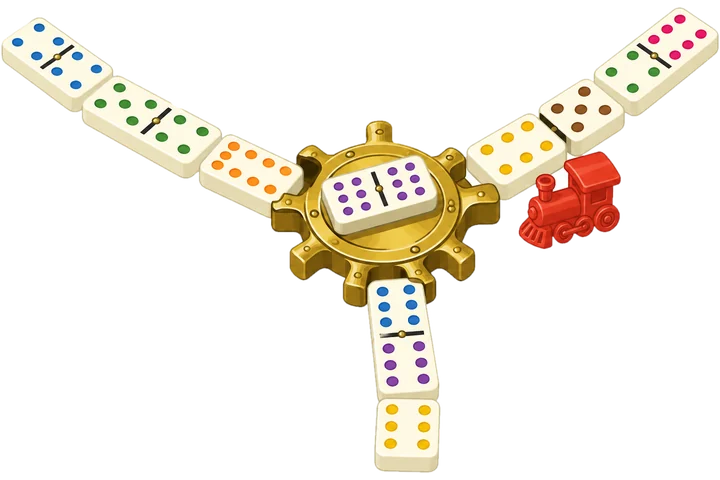
- Players
- 2–8
- Time
- 13 rounds, 1–2 hours
- You need
- Double-12 dominoes, a hub, markers
- To win
- Fewest pips after the last round
What you need
- A double-12 domino set (91 tiles). Double-nine (55 tiles) and double-six (28 tiles) sets work for smaller or quicker games; see double-12 dominoes for what is in each set.
- A station or hub to hold the engine double. It's handy but optional: the double can just sit in the middle of the table.
- A marker for each player. Most sets come with little plastic trains; coins or buttons work just as well.
- Pen and paper for the scores, since the game runs over many rounds, or our Mexican Train score sheet.
Setting up a round
The engine
Every round starts from a double called the engine. In the first round of a double-12 game it is the 12-12. Take it out of the set and place it in the station. The next round uses the 11-11, then the 10-10, all the way down to the 0-0 in the last round, so a full double-12 game has 13 rounds.
Shuffle and deal
Turn the remaining dominoes face down and mix them. Each player draws their hand and stands the tiles on edge so the others can't see them. Whatever is left over is the boneyard, which players draw from during the round.
Dominoes dealt to each player:
| Players | Double 12 | Double 9 | Double 6 |
|---|---|---|---|
| 2 | 15 | 10 | 7 |
| 3–4 | 15 | 10 | 5 |
| 5–6 | 12 | 8 | – |
| 7–8 | 10 | 6 | – |
A double-six set doesn't have enough tiles for more than four players. Different boxes print slightly different numbers; what matters is that a good pile is left in the boneyard, so agree on the count before you deal.
Who goes first
Choose a first player any way you like, then move the start one seat to the left each round so nobody always has the advantage of going first. Play moves clockwise.
The trains
Your own train
Each player builds one personal train, a line of dominoes running from the engine toward their seat. The first domino on it must match the engine: in the 12-12 round, that means a tile with a 12 on one end. Each tile after that must match the open end of the line, the way ordinary dominoes do. Lay tiles end to end with the matching numbers touching.
The Mexican Train
The Mexican Train is one extra train that belongs to nobody. Anyone may start it, again with a tile that matches the engine, and anyone may add to it on their turn. It is always open.
Markers
Normally only you can play on your own train. When you can't play on your turn, you put your marker at the end of your train. While the marker is there, every player may play on your train. The moment you play a domino on your own train again, take the marker off and it is private once more.
Taking a turn
- Play one domino that matches the open end of your own train, the Mexican Train, or any train with a marker.
- If you can't play, draw one domino from the boneyard. If it fits somewhere you are allowed to play, you may play it straight away.
- If it still doesn't fit, pass and put your marker on your own train. Your turn is over.
- When the boneyard is empty, a player who can't play just passes and marks their train.
You only ever play one domino per turn, unless it is a double.
Doubles
Play again after a double
A double is placed crosswise across the end of the train. When you play one, you immediately take another turn, and that next domino must cover the double: it has to go on the same train, matching the double's number.
A double must be covered first
If you can't cover your double, draw one domino. If that doesn't cover it either, put your marker on your own train and your turn ends. The double stays open, and every following player must try to cover it before doing anything else, drawing and marking their own train if they can't. Nobody may play anywhere else until the double is covered. Covering it can be done by anyone: it doesn't matter whose train the double is on.
Ending on a double
If your last domino is a double, playing it ends the round. You don't need to cover it.
Ending a round
A round ends as soon as one player plays their last domino. It also ends if the boneyard is empty and no player can make a play, so that a full lap of the table goes by with everyone passing. That is a blocked round, and nobody goes out.
Many tables ask players to say "last domino" or tap the table when they are down to one tile, so the others know to get rid of their high tiles.
Scoring
At the end of every round, each player adds up the pips (dots) on the dominoes still in their hand and writes the total down. The player who went out scores zero. Points are bad: after the last round, the player with the lowest total wins.
Example: you are caught holding 9-7, 4-0 and 3-3. That's 16 + 4 + 6 = 26 points for the round. A blank tile end counts as zero, so the 0-0 is worth nothing in the standard rules.
House rules and variations
Common changes
- Lay out your first train. On a player's first turn of each round, they may play as many tiles as they can in a chain on their own train. It speeds up the opening; our online game plays one tile per turn.
- Mexican Train after your own. Some groups only let you play on the Mexican Train once your own train is started.
- Several doubles in a row. Some tables let you play more than one double in a turn and then cover them in the order they were played.
- Double-blank penalty. The 0-0 left in your hand counts 50 points instead of zero.
- Shorter games. Play from the 12-12 down to the 6-6, or a fixed number of rounds.
Mexican Train vs Chicken Foot
Chicken Foot uses the same dominoes but has no personal trains or markers. When a double is played, three tiles must be played on it, fanning out like a bird's foot, before play can go anywhere else. Many people know both games, so it's worth checking which rules your table has in mind. The full Chicken Foot rules are on their own page.
Tips
- Before your first play, sort your hand into a chain that starts from the engine number. That is your plan for your own train.
- Keep your own train private. Use the Mexican Train and open trains for tiles that don't fit your plan, so you never have to mark your train.
- Throw high tiles early. Being caught with the 12-11 costs 23 points; a handful of low tiles costs far less.
- Play a double only when you hold a tile to cover it, or when covering it will hurt the next player more than you.
- A marked train is an opportunity: drop an awkward tile on an opponent's open train.
There is more, with a worked example, in our Mexican Train strategy guide.
Play Mexican Train online
The best way to learn is to play a few rounds. Our free online Mexican Train game deals, checks every move and keeps the score. Play against computer players, pass one phone around the table, or set up a private room for friends with no account needed.
Frequently asked questions
How many dominoes does each player get in Mexican Train?
With a double-12 set, the usual deal is 15 each for two to four players, 12 each for five or six, and 10 each for seven or eight. Smaller sets deal fewer: see the table on this page. Boxes and families differ by a tile or two, which is fine as long as everyone agrees before the deal.
Can you play on the Mexican Train before starting your own train?
In the most common rules, yes: the Mexican Train is open to everyone from the first turn, and you can start it or add to it whenever you like. Some families only let you use it once your own train has its first tile; that is a house rule.
What happens if you can't cover a double?
Draw one domino. If it covers the double, play it. If not, put a marker on your own train and your turn ends. The next player must cover the double, drawing if they need to, and so on around the table until someone covers it.
Can you go out on a double in Mexican Train?
Usually, yes. If your last domino is a double, playing it ends the round even though nobody covers it. Some groups require the double to be covered first, so the player has to draw instead; agree before you start.
What happens when the boneyard runs out?
Play goes on without drawing. A player who can't play simply passes and puts a marker on their train. If every player passes in turn and nobody can play, the round is blocked and ends; everyone scores the pips in their hand.
How many rounds are there in Mexican Train?
One round for every double in the set: 13 rounds with double-12 dominoes (12-12 down to 0-0), 10 with double-nine and 7 with double-six. For a shorter game, play half the rounds or stop at an agreed time.
Who wins Mexican Train?
The player with the lowest total after the last round. Points are the pips left in your hand at the end of each round, so the aim is to go out first, or at least to be caught holding small tiles.
What is the difference between Mexican Train and Chicken Foot?
Both are played with the same kind of dominoes and both start from a central double, but in Chicken Foot there are no personal trains or markers. Every double must be covered by three tiles fanning out like a bird's foot before play continues anywhere else, and the double-blank is often worth 50 points.